Art Nouveau Glass Windows Stained Glass Windows Art Nouveau
| Summit: Begonia loving cup by Emile Gallé (1894); Center: Favrile glass by Louis Comfort Tiffany (1900–1902); Bottom: Vases by Johan Loetz Witwe (1900) | |
| Years agile | 1890s–1914 |
|---|---|

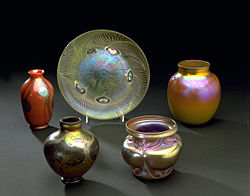

Fine art Nouveau glass is fine glass in the Art Nouveau style. Typically the forms are undulating, sinuous and colorful art, ordinarily inspired by natural forms. Pieces are by and large larger than drinking spectacles, and decorative rather than practical, other than for use as vases and lighting fittings; there is trivial tableware. Prominently makers, from the 1890s onwards, are in France René Lalique, Emile Gallé and the Daum brothers, the American Louis Comfort Tiffany, Christopher Dresser in Scotland and England, and Friedrich Zitzman, Karl Koepping and Max Ritter von Spaun in Germany. Art Nouveau drinking glass included decorative objects, vases, lamps, and stained glass windows. Information technology was usually fabricated by hand, and was usually colored with metal oxides while in a molten state in a furnace.
Techniques and innovations [edit]
Art Nouveau glass was in big part due to technical innovations that allowed drinking glass to accept more and better color, to more than lustrous, and to take more unusual forms. Some of these techniques had been used for centuries, merely Art Nouveau glass artists greatly expanded the means they could be used.
- Aventurine drinking glass was outset invented in 17th or 18th century Venice. It is made to imitate aventurine quartz, it is a yellow glass filled with flecks of sparkling copper particles.
- Cameo drinking glass is like cased glass, with two layers of different colors. The outer layer is then engraved with a diamond bespeak or etched with acid to create a 2-colour design.
- Cased glass is made of 2 layers, often of different colors, ane inside the other. The outer layer (overlay) is created first, then the inner layer is blown inside the first, and so the whole piece is heated so the layers fuse together.
- Crackled glass was glass filled with webs of small cracks and fissures, refracting light and causing the glass to have a sparkling consequence.[ane]
- Émaux-Bijoux was a technique invented by Emile Gallé. Translucent layers of enamel were congenital up in layers and then fused to a foil of precious metallic, which was then heated and fastened to the outside of the glass object.
- Favrile glass was a type of glass invented by Louis Condolement Tiffany. Molten glass was treated with metallic oxides that were absorbed into the drinking glass and created a distinctive irised surface consequence.
- Flashed glass fused a thin outer layer of drinking glass to a thicker glass object, ofttimes of a different color. The larger object was dipped into molten glass, then heated to fuse the outer layer to the object. The outer layer could then be etched, oft diamond, to reveal the color below.
- Glass marquetry was a technique developed by Émile Gallé in Nancy. It was similar to marquetry in wood, a method of adding colors that are integral to the trunk of the piece. It involves adding thin layers of colored glass to the exterior of a drinking glass object, often with a thin layer of articulate crystal as the outer layer. He and so fired the piece in the oven, and so the outside surface was etched by acrid or engraved with a diamond to expose the blueprint in the layers beneath.[2]
- Pâte de verre or drinking glass casting is a form of kiln casting which was oftentimes used by Émile Gallé and Daum Drinking glass. In this procedure, finely crushed glass is mixed with a binding material, such as a mixture of gum arabic and water, and often with colorants and enamels. The resultant paste is applied to the inner surface of a negative mould forming a coating. Later on the coated mould is fired at the appropriate temperature the glass is fused creating a hollow object that can have thick or thin walls depending on the thickness of the pate de verre layers.[iii]
-

Glass marquetry with clematis flowers by Emile Gallé (1890–1900)
-

Crackled glass vase by Emile Gallé, with enamel praying mantis and cigales applied to surface (1889)
France - Émile Gallé and the Daum brothers [edit]
The city of Nancy in French republic was an of import center for Art Nouveau glass manufacture. The dominant effigy in the early on style was Émile Gallé of that city. He learned glassmaking in the factory of his father in Nancy, which also made furniture and ceramics. He studied philosophy, botany and zoology, and besides studied painting. He made report trips to London and Paris, where he discovered Japanese art and decoration, which he practical to his glass. He inherited the family unit house in 1884, and produced a remarkable series of glass objects, using techniques of engraving glass borrowed from Chinese art glass, and methods of layering plaques of glass. He besides developed methods to improve the colour and luminosity of glass, without losing clarity. He presented his Art Nouveau works with success at the Paris Universal Exposition of 1900, and was a founder of the Ecole de Nancy, bridging together architect, glass and piece of furniture designers.[4]
-

Begonia Rose cup by Émile Gallé (1894). Glass marquetry and engraving, overlays applied to surface
-

Engraved crystal vase past Gallé, circa 1900
Glassware and crystal were arts for which Nancy became particularly known. The glassmaker Jean Daum emigrated to France in 1878 and started his ain studio, Daum Glass, which was inherited past his two sons, Antonin Daum and his brother Auguste Daum. They guided the company into the Art Nouveau. The Daum brothers expressed their goal at the terminate of the 1880s: "to use in an industrial fashion the true principles of decorative fine art."[5]
Their method was to produce objects in series, as well as ane-of-a-kind items, and they adapted well to the new technology of electric low-cal bulbs. The vases and lamps usually had very uncomplicated designs taken from plants or vegetables, with monochrome or richly varied colors of many dissimilar layers of glass within the lamp.[6]
-

Daum lamp with trees and fallen snowfall (c. 1900)
-

Daum crystal vase with iris flowers (c. 1900)
-

Daum vase with cricket design (1900)
-

Daum Bonbon container with cornflower design of engraved glass, enamel, and gold past Daum (1901)
-

Tulip vase by Antonin Daum (1910)
France - René Lalique [edit]
René Lalique was some other prominent designer of Art Nouveau drinking glass. Beginning in 1895 he made pieces for the shop of Samuel Bing, the Maison de 50'Fine art Nouveau, which gave Art Nouveau its name. He met the perfume creator François Coty and in 1908 He pioneered in the design of perfume bottles, small glass symbols of modernity, which became a new genre of drinking glass art. 1 example was the sepia stained glass canteen for 'Ambre Antique' Perfume. Another original blueprint by Lalique was a carbohydrate bowl made of sepia stained glass, wrapped in serpents made of silver. (Encounter paradigm below)
Glass Casting and other artists in French glass art [edit]
Henri Cros was another notable effigy in French glass, who rediscovered the ancient Roman technique of pate-de-verre, or glass casting that was described by Pliny. It was made by mixing, when cold, crushed glass, powdered enamels, and binder, unremarkably h2o. The paste is practical to inner surface of a mold, and so fired. When the firing is done, the mould is removed. If the drinking glass slice does not crumble, it is a fully-colored free-standing piece of sculpture. The glass paste was used past other French glassmakers, including Albert Dammouse, Georges Despret and Francois Deorchement.[7]
Other notable figures in French glass art included Muller Frères, a group of brothers originally from Alsace, whose members had fled from Alsace to Nancy subsequently the German occupation in 1871. The brothers were skilled craftsmen, who establish employment at first with Emile Gallé, then prepare up their ain factory nearby in Lunéville. They became expert in drinking glass engraving techniques, especially acrid carving and also in layering glass, adding as many as vii colors. They likewise followed the lead of Gallé in their pick of subjects, focusing on flora and animals. They opened upwards a collaboration with the Belgian business firm Val-Saint-Lambert, and developed with them a new technique of enamelling and engraving called fluogravure, simpler and with fewer risks of breaking than the method used by Gallé and the Daum brothers. It involved touching the different layers of drinking glass with enamels of diverse tones, then using acid to gear up the colors.[8]
-

Cup of glass casting by Albert-Louis Dammouse (Musée d'Orsay)
-

Glass-casting work by Francois-Emile Décorchemont (1910). Dark light-green and blueish grass with brown glass paste attachments. (Petit Palais)
-

Les Baies (Berries) vase by Muller Frères. Double glass, devitrified on surface, etched with hydrofluoric acid and busy with colored enamels, (Petit Palais Museum) (c. 1900)
The U.s.a. - Louis Condolement Tiffany [edit]
Louis Comfort Tiffany was the leading figure in American Art Nouveau glass design. His father was a famous New York jeweler, and he studied painting in New York and Paris before opening a business firm of interior decoration in New York in 1897. He founded the Tiffany Drinking glass Company in 1885, which became the Tiffany Studio subsequently 1900, and opened his ain glass factory on Long Island in 1892. In the early on 1890s, working with Arthur Nash, an English glassmaker from Stourbridge England, he invented a method for blending dissimilar colors of drinking glass in a molten state in a furnace. They also treated drinking glass with diverse metal oxides and exposed it to acid fumes to reach more bright lustre and low-cal furnishings. Tiffany named this kind of Favrile glass, from the Old English language word 'fabrile' or handmade.[ix] Tiffany marketed his early Art Nouveau works at the gallery of Samuel Bing in Paris, which gave Fine art Nouveau its name. He was peculiarly known for his floral lamps, which became emblems of the Art Nouveau style. Some of the well-nigh famous Tiffany lamps were designed by one his artists, Clara Driscoll.[ten]
-

-

Jack-in-the-pulpit vase, Louis Condolement Tiffany, U.S. (1910)
-

Vienna - the Vienna Secession - Johann Loetz Witwe, Otto Wagner and Koloman Moser [edit]
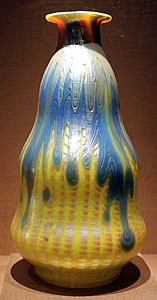
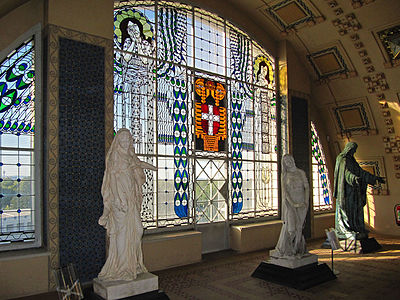
Drinking glass, specially stained glass windows, played a significant part in the Vienna Secession. Unlike the glass fine art of the Art Nouveau in France, the Secession glass designs were geometric and abstract, without the curving lines and natural forms of the earlier style. Leopold Forstner was an important artist in this domain, working closely with Otto Wagner and other architects. He designed the windows for the Austrian Postal Savings Depository financial institution, one of the landmarks of the Vienna Secession style, and besides for the St. Charles Borromeo Cemetery Church building, the almost notable of Vienna Secession churches.
Another notable glass designer of the Vienna Secession was the architect Otto Prutscher, who was role of the Wiener Werkstätte created highly abstract and geometric forms for the far removed from the natural forms of the early Art Nouveau.
-
-
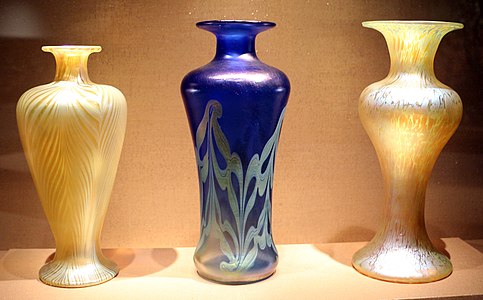
Iridescent vases past Johann Loetz Witwe (1900)
-
Belgium - Philippe Wolfers, Serrurier-Bovy, and Val Saint Lambert [edit]
One of the leading Belgian art glass designers was Philippe Wolfers, whose work included the vase "Les Chardins" in 1896} and a more abstract "Twilight" vase in 1901. The Belgian designer Gustave Serrurier-Bovy created vases and other works that were similar to the Secession mode, made of metal and glass in geometric forms. The Belgian crystal firm of Val Saint Lambert produced crystal Fine art Nouveau vases in more traditional floral designs.[eleven] These included works by the artist Philippe Wolfers, such as his "Crepescule" vase (1901). The architect Victor Horta also created stained glass designs for his interiors. (See Stained Glass windows below)

Britain - Christopher Dresser [edit]
The Scottish creative person Christopher Dresser, from Glasgow, was a leading figure in Art Nouveau glass in the United Kingdom. Unlike almost drinking glass artists of the time, he showed footling involvement in purely natural forms such equally plants and flowers. He was a member of the movement known as Aestheticism, and also was associated with Symbolism and the Anglo-Japanese style, which adjusted Japanese aesthetics to European subjects.
-

"Clutha" glass vase by Christopher Dresser (1890) (Metropolitan Museum of Fine art)
-

"Clutha" drinking glass dish by Christopher Dresser (1890s) (Metropolitan Museum of Fine art)
Stained glass windows [edit]
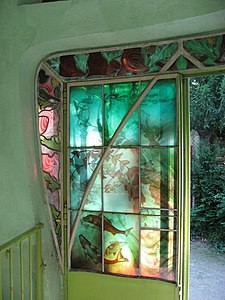
Victor Horta, the Belgian architect who designed some of the primeval Art Nouveau houses, used stained glass windows, combined with ceramics, forest and iron ornamentation with like motifs, to create a harmony between functional elements and decoration, making a unified work of art. One example is the stained glass window of the doorway of the Hôtel van Eetvelde in Brussels (1895).
In France, Art Nouveau stained drinking glass was used by Alphonse Mucha to decorate the interior of the jewelry shop of Georges Fouquet. The windows were fabricated by Léon Fargues. The decor is at present establish in the Carnavalet Museum. One of the largest and last examples of Art Nouveau decorative drinking glass in Paris is the cupola of the Galeries Lafayette Section store (1912).
Early on Fine art Nouveau stained glass generally used traditional techniques and subjects, but usually featured floral themes and women as the central figures. The windows fabricated past Louis Comfort Tiffany, such as those made for the "Instruction" window at the Yale University Library (1887–xc) were particularly lavish, with painted figures. Later, every bit in his stained glass window of Oyster Bay, he used the Favrile glass procedure that he patented, in which the molten glass was tinted with metal oxides to give its surface an iridescent effect.
Later, in Vienna, the artists of the Vienna Secession created more abstruse, simpler and more geometric stained glass designs. Koloman Moser designed decorative angels for the windows of the Kirche am Steinhof, a church built by Otto Wagner (1905).
Józef Mehoffer created the windows for the eight side chapels of Fribourg Cathedral between 1895 and 1918, made by the Fribourg stained glass workshop Kirsch & Fleckner. His windows document the influences of Art Nouveau, Symbolism, Historicism and folk art. The Martyrs' Window (1898-1899) is particularly influenced by Fine art Nouveau. It was awarded a gold medal at the World Exhibition in Paris in 1900.
In Moscow, the Russian architect Fyodor Schechtel used stained glass windows to create the atmosphere of his most Fine art celebrated Nouveau house, the Ryabushinsky House, at present the Gorky Museum. He also used Art Nouveau glass to create the striking lamp in the shape of a jellyfish that ornaments the master stairway.
Notes and citations [edit]
- ^ Bloch-Dermant 1980, p. 195.
- ^ Bloch-Dermant 1980, p. 198.
- ^ Bloch-Dermant 1980, p. 152.
- ^ Fahr-Becker 2015, p. 398.
- ^ Fahr-Becker 2015, pp. 123–126.
- ^ Fahr-Becker 2015, p. 123.
- ^ Bloch-Dermant 1980, p. 168.
- ^ Bloch-Dermant 1980, pp. 160–163.
- ^ "Objects of Beauty- Art Nouveau glass and Jewellry". Victoria and Albert Museum, London. Retrieved January 23, 2020.
- ^ Fahr-Becker 2015, p. 411.
- ^ Thiébaut 2007, p. 238.
- ^ Brumfield, William Craft, Fedor Shekhtel - Aesthetic Idealism in Modernist Compages, Chapter Four, p. 131–139
Bibliography [edit]
- Bloch-Dermant, Janine (1980). The Art of French Glass (1860-1914). The Vendome Press. ISBN0-86565-000-four.
- Fahr-Becker, Gabriele (2015). L'Art Nouveau (in French). H.F. Ullmann. ISBN978-iii-8480-0857-5.
- Garner, Philippe (1976). Gallé (in French). Flammarion. ISBN2-08-012956-two.
- Thomas, Valerie (2009). Le Musée de l'École de Nancy (in French). Somogy. ISBN978-ii-7572-0248-7.
- Sembach, Klaus-Jürgen (2013). L'Art Nouveau- L'Utopie de la Réconciliation (in French). Taschen. ISBN978-3-8228-3005-5.
- Thiébaut, Olivier (2007). Un Ensemble Fine art Nouveau - La Donation Rispal (in French). Musée d'Orsay - Flammarion. ISBN978-2-0801-1608-6.
0 Response to "Art Nouveau Glass Windows Stained Glass Windows Art Nouveau"
Post a Comment