Dick and Jane Books to Read on the Phone
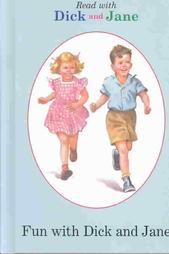
Dick and Jane are the two main characters created by Zerna Sharp for a series of basal readers written by William S. Gray to teach children to read. The characters commencement appeared in the Elson-Greyness Readers in 1930 and continued in a subsequent series of books through the final version in 1965. These readers were used in classrooms in the U.s. and in other English-speaking countries for almost four decades, reaching the elevation of their popularity in the 1950s, when lxxx percent of first-grade students in the United States used them. Although the Dick and Jane series of primers continued to be sold until 1973 and remained in use in some classrooms throughout the 1970s, they were replaced with other reading texts by the 1980s and gradually disappeared from school curricula. The Dick and Jane serial were known for their simple narrative text and watercolor illustrations. Despite the criticisms of the stereotypical content that depicted white, eye-class Americans and the whole-discussion (wait-say) method of teaching reading on which these readers are based, the characters of "Dick", "Jane", and their younger sister, "Sally", became household words. The Dick and Jane primers take likewise become icons of mid-century American culture and collectors' items.
Origins [edit]
The predecessors to the Dick and Jane primers were the phonics-based McGuffey Readers, which were popular from the mid-nineteenth to the mid-twentieth century, and the Elson Bones Readers. William Scott Grayness (1885–1960), director of the Curriculum Foundation Series at Scott, Foresman and Company and dean of the Academy of Chicago's college of teaching, co-authored with William H. Elson the Elson Basic Readers (renamed the Elson-Gray Bones Readers in 1936), which Scott Foresman published in Chicago, Illinois.[i] [two] [three] Gray's research focused on methods to improve reading instruction using content that would exist of interest children and develop their word-recognition skills.[iv] Grayness's vision was to tie "discipline expanse" books in wellness, science, social studies, and arithmetic (each subject field having its own serial of graded texts likewise published past Scott Foresman) with the vocabulary mastered in the bones readers, thus vastly improving readability in these aforementioned areas.[ commendation needed ]
Zerna Precipitous, a old instructor, came up with the idea for what became the Dick and Jane readers for uncomplicated school children while working as a reading consultant and textbook editor for Scott Foresman.[1] [two] She worked with Gray to develop the readers after noting the reduced reading ability of children and urged the utilise of a new reading format for primers. In addition, Sharp developed the principal characters of "Dick" and "Jane", the older blood brother and sister in a fictional family that included "Female parent", "Father", and a younger sis named "Sally", their pets, "Spot" (originally a cat in the 1930s, but a domestic dog in afterward editions), and "Puff", their cat; and a toy teddy bear named "Tim".[5] [6] [7] Sharp named the characters, selected and edited the storylines from ideas that others submitted, and supervised production of the books. Grayness and others wrote the Dick and Jane stories; illustrator Eleanor B. Campbell did most of the early illustrations.[5] [vii]
"Dick" and "Jane" originally appeared in Elson-Greyness Readers in 1930.[one] [2] Before the appearance of the beginning Dick and Jane stories, reading primers "generally included Bible stories or fairy tales with complicated language and few pictures."[v] After the Elson-Gray series ended in 1940, the characters continued in a subsequent series of primary readers that were later revised and enlarged into newer editions.[4] [7] The Dick and Jane readers were widely used in classrooms in the United States and in other English-speaking countries for nigh iv decades and reached the superlative of their popularity in the 1950s, when 80 percent of first-grade students in the United States were learning to read though these stories.[two] [5] [eight] The 1965 edition, the last of the Dick and Jane series, introduced the first Black family as characters in a first-course reader.[7] Although the Dick and Jane series of primers continued to be sold until 1973 they remained in use in some classrooms throughout the 1970s. By the 1980s, the Dick and Jane stories had been replaced with other reading texts and gradually disappeared from schools curriculum.[ii] [v] [8]
Content and illustrations [edit]
William Gray and Zerna Abrupt worked together to develop readers that incorporated the whole-word or wait-say method of word recognition (besides called sight reading).[5] The Dick and Jane primers introduced new readers to one new word on each folio and just five new words in each individual story.[1] [2] Grayness and Sharp as well wanted children who read the books to be able to readily identify with the characters. Sharp chose stories where the characters participated in typical children's activities.[half-dozen] [7]
The Dick and Jane primers taught reading as well as American middle-form values to schoolhouse-anile children. The storylines described the lives and experiences of a stereotypical American eye-class, white family in their suburban home. "Father" wore a suit, worked in an role, mowed the lawn, and done the car. "Mother" stayed at home, did housework, and raised the children. "Dick", the oldest of the family unit's three children, was active and well-behaved; "Jane", the second oldest child, was pretty and carefree. She likewise helped care for "Emerge", the baby of the family.[five] [6] [vii]
The texts and illustrations for the Dick and Jane primers were intended to work together to assistance young readers empathise the story. The texts introduced a repetitive pattern of words;[6] the illustrations provided visual reinforcements to assist convey the meaning of the words.[vii] The simple simply distinctive illustrations for the books were done past artists Eleanor Campbell and Keith Ward. Robert Childress did the illustrations during the 1950s. Richard Wiley took over the illustrations in the 1960s.[ix] The Dick and Jane outset readers became well known for their simple narrative text and watercolor illustrations. Because the primers were intended for nationwide distribution, the text and illustrations intentionally lacked references to specific regional geographical features such every bit mountains, rivers, lakes, plains, or the seashore.[5] [7]
Books published in the series [edit]
- Class 1 – Before We Read, Nosotros Look and See, Nosotros Work and Play, We Come and Get, Guess Who, Fun with Dick and Jane and Our New Friends
- Grade 2 – Friends and Neighbors and More than Friends and Neighbors
- Class 3 – Streets and Roads, More than Streets and Roads, Roads to Follow, and More Roads to Follow
- Transitional 3/4 – Just Imagine
- Grade 4 – Times and Places
- Class 5 – Days and Deeds
- Grade 6 – People and Progress
- Grade 7 – Paths and Pathfinders; Parades
- Grade 8 – Wonders and Workers; Panoramas
- Grade 9 – Helpful in Ways
In the mid-1950s, the texts for grades four, five, and six were split into two books for each grade level, as was originally the design with the lower grades in the serial. The naming blueprint for this group of books added the words "The New" at the outset of the title for the outset volume in each grade level and the give-and-take "More than" to the beginning of the title for the 2nd book in each grade level to form new titles: The New Times and Places and More Times and Places; The New Days and Deeds and More Days and Deeds; and The New People and Progress and More People and Progress.[ citation needed ]
In the late 1950s, the texts for grades seven and 8 were re-packaged into a Bones Reading and Literature series consisting of Book 1 (for seventh course) and Book 2 (for eighth class) without changing whatever of the contents from the original late 1940s versions. As an culling to this more literary approach for these two grades, entirely new texts were published with shorter, simpler readings with the titles of Parades and More than Parades for the seventh form and Panoramas and More Panoramas for the eighth grade. Focusing on targeted reading and word assault techniques, a soft-cover workbook, Basic Reading Skills, was published for the junior high (seventh and/or eighth grade) and intended to be used independently, like to the Think And Do books were used in conjunction with the graded texts at the elementary schoolhouse level.[ citation needed ]
Scott Foresman made changes in their readers in the 1960s in an endeavour to keep the stories relevant, updating the serial every five years.[5] Scott Foresman published Broad Wide World in 1960 for the seventh course; information technology included longer literary selections from authors such every bit Nathaniel Hawthorne, Emily Dickinson, and Rudyard Kipling.[ citation needed ]
In the mid-1960s, Scott Foresman'south New New Basic Readers were heavily revised. The books had a larger folio size, new and updated artwork, some shortened stories from previous editions, and a big portion of new stories. In add-on, the "Dick", "Jane", and "Emerge" characters were a chip older and a bit more sophisticated. Pedagogy procedures also were slightly different: the vocabulary control was looser and more phonics training was added. Helen Thou. Robinson became the head author. The primeval titles, released in 1962, were: Nosotros Read Pictures, We Read More Pictures, Before We Read, Sally Dick and Jane, Fun With Our Family, Fun Wherever Nosotros Are, Estimate Who, Fun With Our Friends, More Fun With Our Friends (all Grade i); Friends One-time and New and More Friends One-time and New (course 2); Roads to Follow and More Roads to Follow (grade 3); Ventures (grade 4); Vistas (grade 5); Cavalcades (class half-dozen); Dimensions (form seven); and Challenges (grade viii).[ citation needed ]
In 1965, Scott Foresman became the first publisher to introduce an African American family as characters in a first-grade reader serial. The family included two parents and their three children: a son, "Mike", and twin daughters, "Pam" and "Penny".[7] In the multi-ethnic edition, the titles of the 1st and 2nd pre-primers were changed to At present We Read and Fun With the Family to reflect the improver of an African-American family. Other books in the series retained the 1962 titles. In add-on, the 1965 edition books were available in ii covers: one comprehend featured characters every bit in previous books; the other comprehend, which many people refer to equally a "fingerpaint" cover, was listed in the Scott, Foresman catalog a "child-art" and did not feature whatever characters. The Call back-and-Do Book workbooks, which began as Silent Reading Workbooks with the Elson readers if the 1930s, were part of the 1950s and the 1960s editions of the updated readers. An experimental Initial Teaching Alphabet version was launched with the multi-ethnic serial in the 1960s equally well.[ citation needed ]
In 1967, two years after Scott Foresman retired the Dick and Jane series, the visitor launched its Open up Highways series, which included heavily illustrated classic children's stories and poems, also equally placing greater accent on multicultural content and phonics preparation in its subsequent readers.[7] Wide Horizons, a compansion series for advanced readers, was introduced as well. Initially, the readers for grades one through seven were indicated every bit "Book 1", "Book 2", and so on, but later editions for each grade-level reader had its own title in the series, such as Ready to Roll and Rolling Along (the Open Highways books for the starting time grade): Moving Ahead and More Ability for the 2nd grade' and Splendid Journeying and Speeding Abroad books for the third grade.[ citation needed ]
Adaptations [edit]
The Dick and Jane readers inspired other publishers to adopt a similar format, but Scott Foresman's Dick and Jane series were the market leaders until the early 1960s,[7] In Cosmic editions of the 1940s, 1950s, and 1960s serial, the "Sally", "Dick", and "Jane" characters were renamed "Judy", "John", and "Jean" to reflect the names of Cosmic saints. Some other series, published past Ginn and Company, featured characters named "David" and "Ann". Groups of stories in each book were replaced past Catholic-oriented stories of the saints or portrayed moral choices. Some 1960s grade-level readers besides had Seventh-day Adventist versions that used the 1965 multi-ethnic characters with revised book title. For case, Now We Read became Friends to Know and Fun Wherever Nosotros Are became Places to Know. W. J. Cuff published British English linguistic communication versions in Canada with appropriate spelling changes. In lower grades French language versions also were issued in the 1950s in Canada, with the main characters renamed Jeanne, Paul, and Lise in these editions,[x] equally well equally British English versions in paperback in the United Kingdom.[ citation needed ]
Teaching methodology [edit]
For three decades (roughly 1940 to 1970), the whole-word or wait-say method (also called sight reading) on which the Dick and Jane readers were based remained the dominant reading method in American schools. Phonics-based reading methods came into fashion in the 1970s. The whole-language move developed in the 1980s. Other methods were also in use for shorter periods before they were replaced also.[xi] [12] The look-say method used a controlled vocabulary and taught readers to memorize the words through repetition, placing less emphasis on educational activity phonics[eleven] Texts in the Dick and Jane readers repeated words within phrases such as "Oh, see. Oh, see Jane. Funny, funny Jane."[ citation needed ] Teacher's guides accompanying the texts too encouraged adoption of the whole-discussion (look-say) method of identifying the meaning of words from the illustrations and repeating words introduced in the text.[vii]
Phonetic analysis was role of each reading lesson, although not to the degree i would associate with learning to read past pure phonics. For this reason, the Dick and Jane readers came to be used less and less as studies supported phonics as a more than effective method of gaining literacy.[ commendation needed ] Texts in the primary grades emphasized Learning to Read, but in fourth grade and above the focus was Reading to Learn, with content becoming very important.[ citation needed ]
Criticisms [edit]
According to the history of the Institute for Juvenile Research, psychologist Marion Monroe developed methods for early on babyhood reading programs, which led to the Dick and Jane stories.[xiii]
Impact on students [edit]
For decades, critics and advocates continued to debate the affect of the sight reading method and the primers that used it.[5] Dr. Samuel T. Orton, a neuropathologist, warned educators in his commodity published in the February 1929 issue of the Journal of Educational Psychology that the look-say method would atomic number 82 to reading disability.[14] In Why Johnny Tin't Read (1955), writer Rudolf Flesch concluded that the whole-word (wait-say) method was ineffective because it lacked phonics preparation. In addition, Flesch was disquisitional of the elementary stories and limited text and vocabulary in the Dick-and-Jane-style readers that taught students to read through word memorization.[fourteen] [7] Flesch and other critics also believed that the look-say method did not properly set students to read more than circuitous materials in the upper form levels.[7] [15] Arther Trace too criticized the Dick and Jane series in his volume, Reading Without Dick and Jane (1965).[16] In 2002, writer Samuel 50. Blumenfeld, a supporter of teaching reading skills with phonics reading, argued that the Dick and Jane series and others that used the whole-word, await-say, or sight-reading method caused poor reading skills among the millions of American students who learned to read using this method.[fourteen] Harold Henderson asserted in his volume, Let'southward Impale Dick and Jane (2006), that the series focused on trivial aspects of reading and left children far behind their peers in Europe.[17]
Bias and stereotypes [edit]
In the late 1950s and early on 1960s, critics of the Dick and Jane readers began to point out its stereotypes; class, gender, and racial bias; and errors in content and illustrations. Critics objected to the Dick and Jane storylines and stereotyped roles, arguing that "many students could not relate to family with two children, a dog named Spot, and a true cat named Puff."[one] Increasing social changes, including the civil rights movement in the 1960s and efforts to include a stronger presentation of other races and cultures in classroom texts, fabricated the white, heart-grade characters of "Dick and Jane seem increasingly irrelevant to some."[5] Zerna Sharp, who created the characters and edited the readers countered the harsh criticisms[6] with the reply, "That's all an adult'south viewpoint."[two]
Although the Dick and Jane primers were already declining in popularity by the mid-1960s, critics continued to attack the look-say method and the content of the readers, peculiarly their gender stereotypes (i.e., the mother staying at home to have intendance of the children and keep business firm, while the father went to work, forth with passive female person characters such as Jane) and lack of racial and cultural diversity.
I take peachy pride in taking Dick and Jane out of most school libraries. That is my greatest satisfaction.[ citation needed ]
You lot larn to read in school with Dick and Jane, just the Dick and Jane stuff was and so dull![eighteen] You lot know, the stories were stupid, even for a first or 2nd grader. Years after I saw some of the famous McGuffey readers, get back farther, things that my female parent's generation would read from in the 1930s or 1920s, and those things were filled with existent stories from existent writers that the kids were learning. But my generation, the baby boomers, nosotros had Dick and Jane, and that couldn't convince me to go on reading. But Batman and Superman could: they were much more than interesting than Dick and Jane.[18] [19]
Collectibles and reprint editions [edit]
The primers that made the characters of "Dick", "Jane", and "Sally" household words have become icons of mid-century American culture, likewise equally collectors' items.[5] [7] First editions of the books sell for every bit much equally US$200. Grosset & Dunlap, an imprint of Penguin Grouping, reissued the books in 2003, and over two.5 1000000 copies were sold, but the publishers warned confronting using them to teach reading to children. Related merchandise, such as shirts and magnets, besides gained wide popularity, peculiarly among people who had never been exposed to the original series, but were familiar with catchphrases such every bit "See Spot run!".[ commendation needed ]
In pop culture [edit]
Ad and branding [edit]
- See Jane Work is a line of organizational products at Office Depot designed by Holly Bohn; the inspiration for the proper name comes from the character Jane.
- Many Target commercials featuring Target Dog included the phrase "See Spot save", a have on of the series' famous "Run into Spot run".[20]
Cartoons [edit]
- In a Calvin and Hobbes cartoon Calvin wrote a book written report titled, "The Dynamics of Interbeing and Monological Imperatives in Dick and Jane: A Report in Psychic Transrelational Gender Modes".
Films [edit]
- Fun with Dick and Jane (1977) and its 2005 remake refers to Fun with Dick and Jane, the championship of the Form ane book in the reading series.
- One sequence of Disney'due south animated characteristic film Tarzan (1999) that is prepare to music features a book with a folio that says, "See Jane, See Jane Run."
- The title of Run into Spot Run is based on a line in the books.
Literature [edit]
- Marc Gallant'due south illustrated parody book, More Fun with Dick and Jane (1986), shows the characters equally grown-ups.[21]
- An excerpt of a Dick and Jane text is used in the opening chapter of Nobel Prize-winner Toni Morrison's novel, The Bluest Eye, and the text is repeated with variations throughout the volume; its idyllic white suburban setting is juxtaposed with that of a black family during the Dandy Depression.[22]
Music [edit]
- The band Man Sexual Response referenced the characters and manner of the books in the vocal "Dick and Jane", from their EP Fig. 14 (1980).
- The band Hawaiian Pups spoofed the characters in the song "Baby Judy", from their EP Carve up 2d Precision (1983).
Television receiver [edit]
- A PBS children'due south television receiver series called Between the Lions does a spoof of the books entitled Fun with Chicken Jane.
- Vocalizer Bobby Vinton recorded a song in the 1970s entitled "Dick and Jane".
- In The Simpsons episode "They Saved Lisa'southward Brain", the Comic Book Guy's T-shirt reads "C:/DOS C:/DOS/RUN RUN/DOS/RUN", similar to the catch phrases in the book series.
- 3rd Stone from the Lord's day 'southward two-part flavour 3 opening episode is titled, "Fun with Dick and Janet"; many of the show's episode titles have various references, with the names of the show's characters added in.
Public exhibitions [edit]
The Dick and Jane readers were featured in an exhibition at Lakeview Museum of Arts and Sciences in Peoria, Illinois, in 1994 and at the Richmond Public Library in Richmond, Indiana, in 1997.[5]
Run across also [edit]
- Alice and Jerry
- Emmet and Bee
- Janet and John
- Janet and Marker
- Cardinal Words Reading Scheme'south Peter and Jane
- McGuffey Readers
- Mr. Mugs
- Science Research Assembly
References [edit]
- ^ a b c d eastward Frederik Ohles, Shirley M. Ohles, and John Thou. Ramsay (1997). Biographical Dictionary of Modern American Educators. Westport, Connecticut: Greenwood Press. p. 290. ISBN0313291330.
{{cite book}}: CS1 maint: multiple names: authors listing (link) (via Google Books) - ^ a b c d e f chiliad Joseph B. Treaster (June 19, 1981). "Zerna Sharp, 91, Dies In Indiana; Originated 'Dick and Jane' Texts". The New York Times. pp. B6. Retrieved July 8, 2019.
- ^ "Biography of Zerna Sharp". Archived from the original on 2005-08-28. Retrieved 2010-02-26 .
- ^ a b Gerald W. Jorgenson. "William Scott Gray (1885–1960)". Educational activity Encyclopedia. StateUniversity.com. Retrieved July viii, 2019.
- ^ a b c d e f thousand h i j k l m Trip Gabriel (Oct three, 1996). "Oh, Jane, Encounter How Popular We Are". The New York Times. p. C1. Retrieved July 8, 2019.
- ^ a b c d due east Linda C. Gugin and James E. St. Clair, ed. (2015). Indiana's 200: The People Who Shaped the Hoosier State. Indianapolis: Indiana Historical Society Press. pp. 304–05. ISBN978-0-87195-387-2.
- ^ a b c d e f yard h i j k l thou n o Elizabeth Tandy (June 9, 2003). "Reading With and Without Dick and Jane: The Politics of Literacy in c20 American, a Rare Book School exhibition". University of Virginia. Retrieved July 8, 2019.
- ^ a b "In Other News: 1927". Indianapolis Monthly. Indianapolis, Indiana: Emmis Communications. 23 (4): 214. Dec 1999. ISSN 0899-0328. Retrieved July 8, 2019.
- ^ Geoff Pursinger (Dec 2, 2009). "The man who 'killed' Dick and Jane." The Times.
- ^ "Encore Paul, Jeanne et Lise Adapte De Good Times With Our Friends past Baruch,Dorothy & Montgomery,Elizabeth | Nerman's Books & Collectibles". www.abebooks.com.
- ^ a b Diane Ravitch (Winter 2007). "The Triumph of Look-Say". Education Next. 7 (1). Retrieved July 8, 2019.
- ^ The whole language approach included children'due south literature, writing, and other communication activities. Encounter: Sharon Cromwell (Baronial 28, 2014). "Whole Language and Phonics: Can They Work Together?". Educational activity World . Retrieved July 8, 2019.
- ^ Beuttler, Fred and Bell, Carl (2010). For the Welfare of Every Child – A Brief History of the Institute for Juvenile Research, 1909 – 2010. University of Illinois: Chicago
- ^ a b c Samuel L. Blumenfeld (September ane, 2002). "The Victims of Dick and Jane". Chalcedon. Retrieved July 8, 2019.
- ^ Natalie Wexler (May xix, 2018). "Why Johnny Yet Tin't Read––And What To Do Near Information technology". Forbes. Archived from the original on May 22, 2018. Retrieved July viii, 2019.
- ^ Arther S. Trace (1965). Reading Without Dick and Jane. Chicago: Regnery.
- ^ Harold Henderson (2006). Let's Kill Dick and Jane: How the Open Court Publishing Company Fought the Culture of American Education . South Bend, Indiana: St. Augustine's Press. ISBN1587319195.
- ^ a b Andrea Warner. "George R. R. Martin: Fantasy for Non-Fantasy People". AbeBooks. Retrieved July ix, 2019.
- ^ "Entertainment". UPROXX.
- ^ No such report exists; information technology was just Watterson making a one-off throwaway joke about a title.
- ^ Gallant, Marc (1986). More Fun with Dick and Jane. Penguin Books.
- ^ "The Bluest Eye Summary and Assay". Cliffs Notes.
Farther reading [edit]
- Kismaric, Carole (2004). Growing Up with Dick and Jane: Learning and Living the American Dream. Harpercollins. p. 21. ISBN978-0-06-076681-8.
External links [edit]
- An article in Us Today.
Source: https://en.wikipedia.org/wiki/Dick_and_Jane
0 Response to "Dick and Jane Books to Read on the Phone"
Post a Comment